On the Brew of Being: Why Better Decisions Don't Come from Will
How readiness, not willpower, shapes clarity and change.

Part I – The Myth of Willpower
I used to think I had to force myself to write. Sit down, clench my jaw, and wrestle something out of the blank page.
It took years to realize that the muse doesn't respond to brute force. Creativity doesn't arrive on command—it slips in when conditions are right. On a walk, in the middle of a workout, folding laundry. It rarely looks like work, until suddenly, it is.
That lesson didn't just change how I create. It changed how I see agency. We're told that good decisions come from grit. From effort. From clarity of thought.
But in my life, the best decisions—the ones that move me forward, deepen relationships, or unlock possibilities—don't feel like effort. They feel like inevitability. Like something downstream from how I've been living.
This isn't an argument against discipline. It's an argument for placing it in the right location.
When I'm sleeping well, eating real food, moving often, reflecting daily—what I call hitting my physical and mental baseline—life flows. I don't have to constantly try to do the right thing. It just happens. My thoughts are clearer. My presence is sharper. My tolerance for ambiguity increases.
Willpower doesn't enter the equation, because the path forward is obvious.
But if I neglect the basics—if I slip below baseline—I start forcing everything. I analyze more, understand less, and second-guess myself through every decision. Life becomes a series of mental negotiations with no satisfying outcome. I know what's right, but I'm not equipped to do it.
This isn't just a personal observation. I believe it's a cultural error. We've built our society on the myth that human beings are best guided by knowledge, belief, and moral clarity—when in fact, we are far more emergent and embodied than we admit.
We are not thinkers who occasionally act. We are actors whose thinking arises from how we live.
If you want better outcomes, you don't begin with answers. You begin with baselines. Because the truth is: what we call "willpower" is often just the residue of having not prepared the conditions for wisdom to emerge.
Part II – The Human Organism as a System, Not a Machine
We often talk about ourselves as if we were machines. Flip the right switch, update the software, fix the bug. It's the language of modern self-help, productivity culture, and even social policy: find the lever, pull it, solve the problem.
But this model—elegant, mechanical, linear—has very little to do with how people actually work.
Human beings aren't machines. We're systems—messy, dynamic, and deeply sensitive to context. Small environmental shifts ripple through us in complex ways.
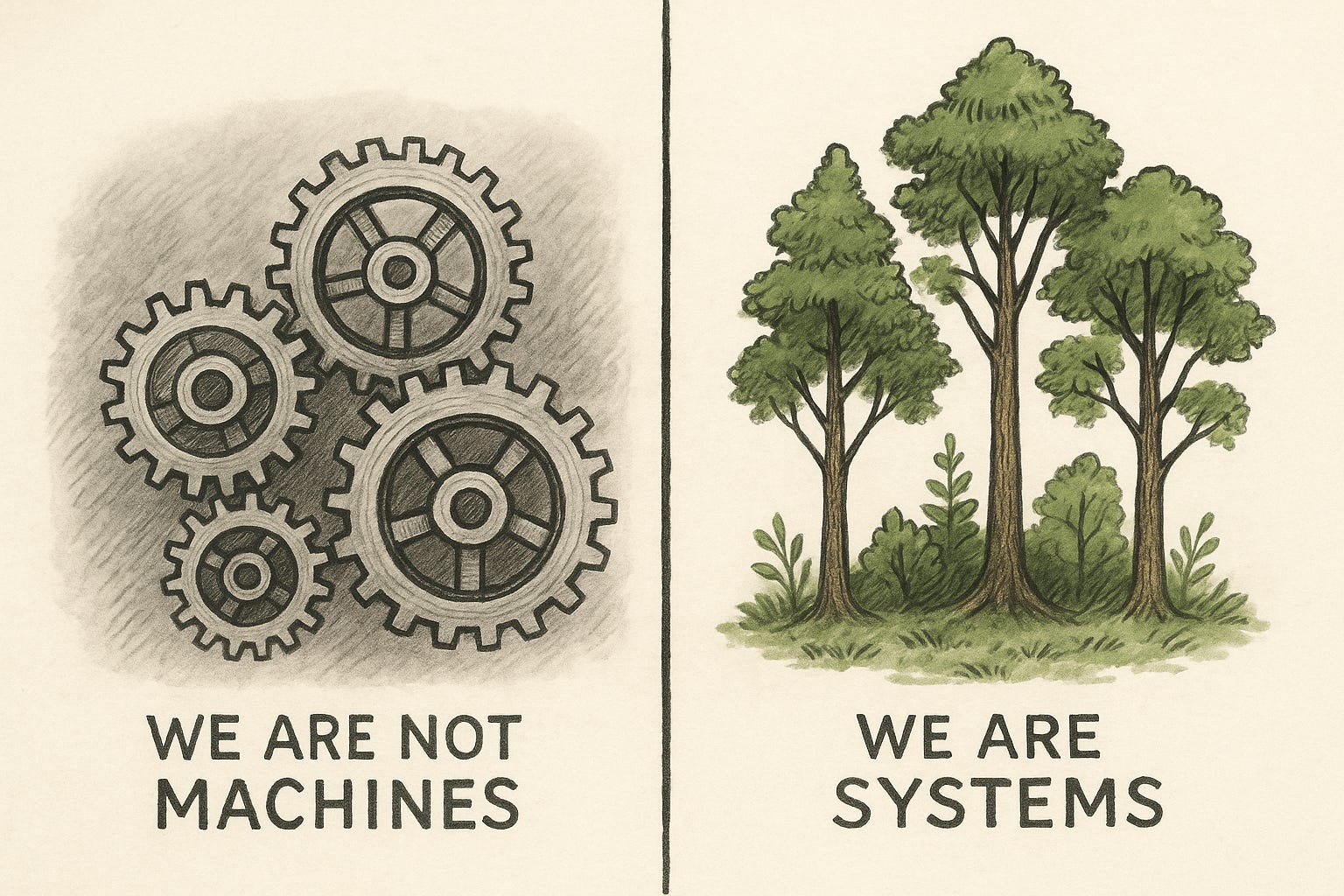
A bad night's sleep can make us irritable in traffic, which alters how we show up to a conversation, which affects someone else's day, which comes back around. There's no isolated cause and effect. There's only feedback, influence, and emergent behavior.
In systems theory, especially in the work of thinkers like Gregory Bateson and Donella Meadows, it's understood that you can't engineer outcomes in a complex system by focusing on outputs alone. You have to tune the system itself—adjust its parameters, change the flow of energy, and build in resilience. You work at the level of conditions, not commands.
The same logic applies to us. You can't will your way to better decisions any more than a forest can will itself to grow. But you can steward the conditions. You can cultivate the soil.
That's what hitting your physical and mental baseline does. It doesn't guarantee brilliance or virtue, but it creates a system where those things can emerge.
What's often missing in our cultural narratives—and our institutional ones—is the humility to admit that we don't fully understand what drives our best behavior.
We treat moral clarity as a sufficient condition for moral action. It isn't. Ask anyone who's ever known the right thing to do and still failed to do it.
The truth is more elemental: we are chemical, hormonal, relational, rhythmic.
You don't get better action by demanding better choices. You get better action by creating a better brew.
That's the heart of it. The human organism is a brew—a dynamic swirl of energy, memory, biology, and environment. Every day, countless interactions take place inside this brew, too many for any intelligence to predict or control.
But we can influence the brew. We can add ingredients, regulate the temperature, and change what goes in the pot.
Want better outcomes? Start with the brew.
Part III – PMBaseline: A Theory of Emergent Good
There’s a familiar pattern in modern life: something feels off—anxiety, distraction, fatigue—and we respond by trying to think our way through it. We double down on productivity hacks, decision matrices, and philosophical inquiry.
We try to will better outcomes into existence.
But often, the problem isn't conceptual. It's physiological. It's emotional. It's environmental. And more importantly, it's systemic.
That’s the origin of PMBaseline—not as a brand or app, but as a guiding philosophy. A simple idea: before you try to make better decisions, try becoming a more stable system.
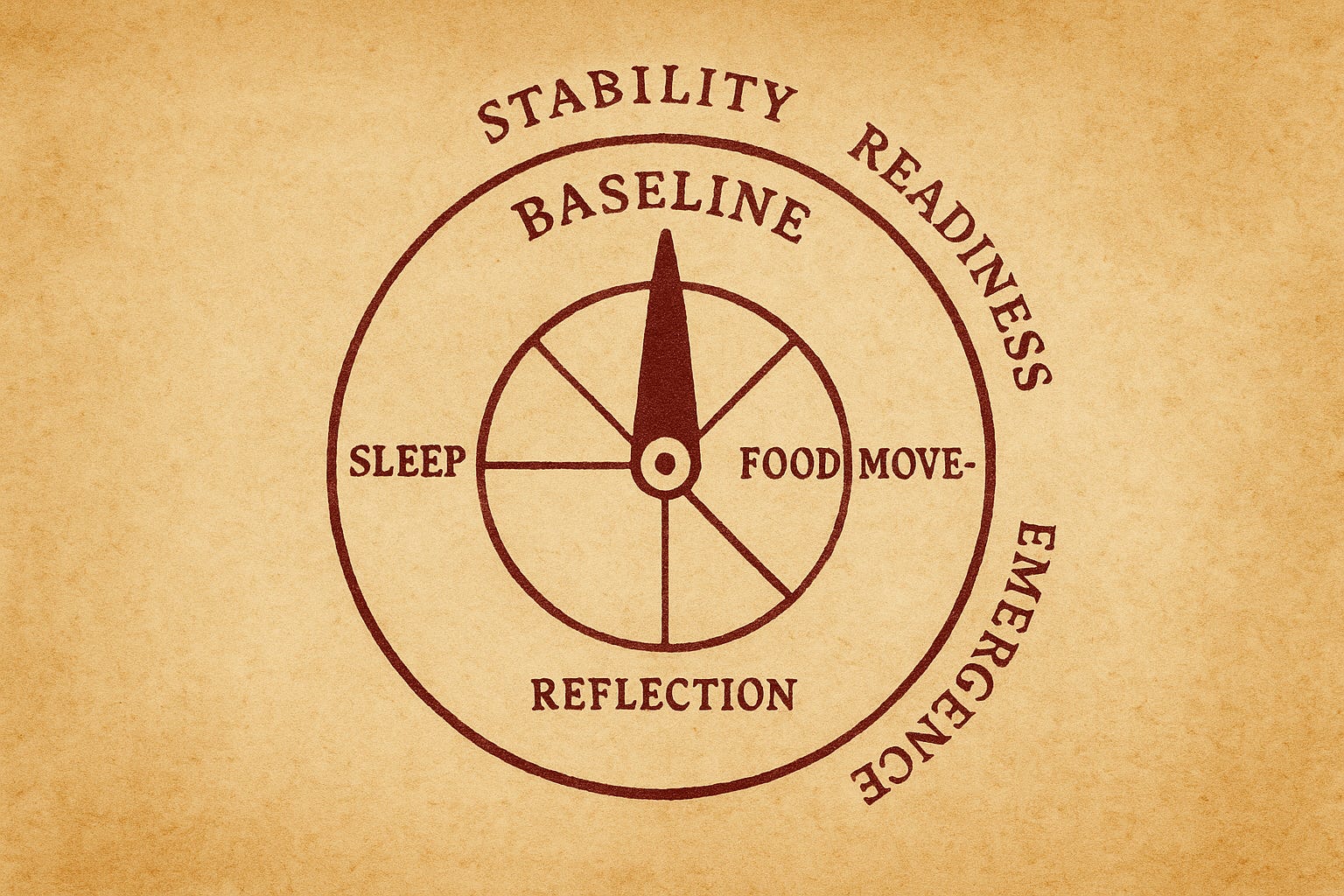
The name stands for Physical and Mental Baseline. It refers to the foundational conditions from which sustainable clarity, creativity, and contribution arise. It's not a wellness routine or a lifestyle brand—it's an operating principle.
The principle is this: when the system is tuned, better outcomes emerge without effort. Not because you've become more virtuous, but because you've become more coherent.
The logic is rooted in complexity theory and behavioral psychology. In complex systems, outcomes are not controlled—they emerge from the structure of the system itself.
Likewise, in behavioral science, we see that habits aren't formed by insight alone but by scaffolding the environment: cues, feedback loops, frictionless paths.
PMBaseline takes this logic seriously. It asks: what if the best metric for human potential isn't intelligence or education, but the ability to maintain internal stability over time?
What if discipline, when aimed not at outcomes but at conditions, becomes the true driver of flourishing?
This is not about perfection. It's about participation. You don't have to be optimized—you just have to be engaged.
That’s why the PMBaseline check-in isn't about performance. It's about presence. Did you show up today for yourself? Did you tend to the system? That's it.
Because once the system is tuned, the muse arrives. The insight appears. The decision makes itself.
And scaled across a society, this shift—from will to readiness, from command to cultivation—may be the difference between chaotic collapse and emergent good.
🌀 If this resonates, consider subscribing to follow the larger PMBaseline journey—essays, prototypes, and systems for a more coherent world.
Part IV – Against the Tyranny of Knowing
In times of uncertainty, we double down on certainty. We want answers, blueprints, and positions. We want to know what's right. Not just for ourselves, but for everyone.
This impulse is understandable. It's also dangerous.
The modern world is saturated with ideological clarity. Movements compete not just over goals, but over frameworks—over whose way of understanding the world is correct, moral, urgent.
But the more tightly we grip our frameworks, the more brittle our thinking becomes. The desire to know can start to crowd out the ability to listen.
This is what I call the tyranny of knowing: the mistaken belief that the path to a better world lies in greater intellectual certainty.
That if we can just think hard enough, read widely enough, and master the correct language or theory, we will arrive at the right answer and build from there.
But clarity doesn't guarantee coherence. And coherence doesn't guarantee contribution. Plenty of people are sure of their worldview while living in contradiction with their own bodies and communities.
Plenty of activists burn out. Plenty of smart people spiral.
The intellect alone cannot carry the weight of transformation—not personal, and certainly not collective.
Social change isn't a math problem. It's a movement of organisms—human systems, chemical systems, emotional systems, historical systems—interacting in ways no one can fully map.
To navigate this terrain, you don't need more certainty. You need more readiness.
This is where PMBaseline becomes not just a personal tool, but a political theory. Not political in the partisan sense, but in the deeper sense: a philosophy of how we live together.
Most movements for change focus on ideas—who has the right ones, who's on the right side. But what if that's the wrong axis entirely?
What if the true crisis isn't a crisis of belief, but a crisis of embodiment?
What if the reason we can't solve our biggest problems is that too many of us are living below baseline: dysregulated, depleted, and disoriented?
You don't build a better society by force-feeding it better beliefs. You build a better society by fostering the conditions from which better choices naturally arise.
And that starts—humbly, quietly—with breath, food, rest, movement, reflection. Not as a retreat from the world, but as the only foundation stable enough to carry it.
Part V – Social Change as Emergence, Not Blueprint
Most models of social change follow a familiar pattern: identify the problem, design a solution, mobilize support, implement reform.
It's the logic of the blueprint—rational, linear, and controllable. But that's not how real change tends to unfold.
Real change is emergent. It arises not from control, but from conditions. It doesn't move in straight lines. It bubbles up, gains traction, folds in on itself, morphs, spreads. It's evolutionary, not engineered.
This distinction matters because it shifts our focus.
If we believe in the blueprint model, we'll put most of our energy into ideology, rhetoric, and structural design. But if we take emergence seriously, we start thinking like gardeners—or systems thinkers.
We focus on inputs, interactions, thresholds, and feedback loops.
We stop asking, "What's the right answer?" and start asking, "What makes better answers more likely to arise?"
This is where PMBaseline finds its footing as a social theory.
By helping individuals stabilize their internal systems—not perfectly, but consistently—we raise the baseline from which decisions emerge.
Not just better decisions, but different kinds of decisions. Less reactive. Less brittle. More grounded. More generative.
It's not that people suddenly become enlightened—it's that the kinds of questions they ask begin to change. The kinds of relationships they foster begin to shift.
The space between stimulus and response widens just enough for reflection to enter. And reflection, repeated and embodied, is the raw material of culture.
There's also a protective function here — and it's critical. When people are dysregulated, they become susceptible to ideology, polarization, and extremism. Their bandwidth narrows. Their fear circuits light up.
They cling to whatever offers certainty, even if it leads to harm.
A society filled with dysregulated individuals is a society primed for volatility.
But if you raise the baseline, even modestly, you reduce the risk of runaway reaction. You make space for patience. For humility. For self-correction.
You create a culture where people don't just know better, but are capable of acting better.
That's the quiet promise of baseline theory: not utopia, not perfection, but resilience.
A society that tilts toward coherence not by decree, but by design. Not from the top down, but from the inside out.
Part VI – A Philosophy of Readiness
There's a moment that happens sometimes on a walk—no headphones, no agenda—when an idea arrives unannounced. Not something I chased, but something I caught.
A phrase. A structure. A shift in perspective. It feels like the world is handing me something I didn't know I needed.
That's the muse.
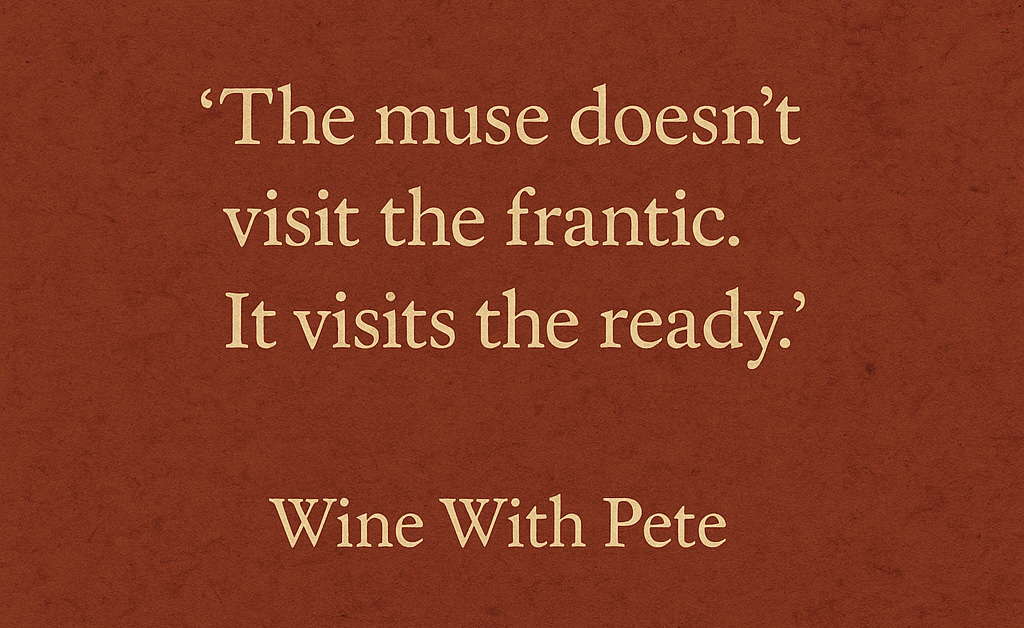
But the muse doesn't visit the frantic. It visits the ready.
The same is true for life. For growth. For change.
The breakthroughs come not from grinding harder, but from tuning the system.
Not from willing the answers into existence, but from becoming the kind of person, the kind of culture, where the answers can land.
This is what PMBaseline points toward. Not optimization and not performance, just readiness.
Just the simple, disciplined act of getting your system to a place where it can receive what the world is already offering.
It's a philosophy of trust. Trust that coherence breeds clarity. That health breeds intelligence.
That a society built on baseline maintenance will yield more good than one built on moral warfare.
Not because it imposes goodness, but because it fosters the conditions where goodness becomes more likely.
In a world obsessed with action, there's something radical about being ready.
About walking without headphones. About sleeping deeply. About eating well and breathing fully and showing up for your own mind.
Not because it makes you virtuous, but because it makes you available.
To truth. To insight. To change. To others.
We are not machines. We are brews.
And brews don't respond to force. They respond to heat, to time, to what's in the pot.
You want better outcomes? Stir the pot. Change the ingredients. Raise the baseline.
And trust that what emerges—slowly, quietly, steadily—might be better than anything you could have willed into being.